Celebration Season Begins: Preparing Our Home (and Hearts) for What’s Ahead
The last days of October carry a certain charge — the kind of quiet hum that says something’s beginning.
At Robins Hollow, the scent of wood smoke mingles with salt air, and the light filters soft through bare branches. Inside, the floors creak with purpose: we’re cleaning windows, setting tables, and brushing off the faintest layer of sawdust before guests arrive.
November marks the true start of what we call celebration season — the rhythm that begins with Sean’s birthday and carries through the holidays. His birthday lands right at the hinge between months, when Halloween’s glow fades into November’s gratitude, and it’s always our cue to gather the people we love most.
Sean’s not as big birthday person as I am. I take August on as a month-long Leo-season holiday. But his quieter kind of celebrating — family, food, laughter that lingers — has taught me something about the beauty of doing things simply and well.
Every year, as we start preparing, I’m struck by how the same skills that make for a joyful celebration also hold together an old house, a good year, and a good life.
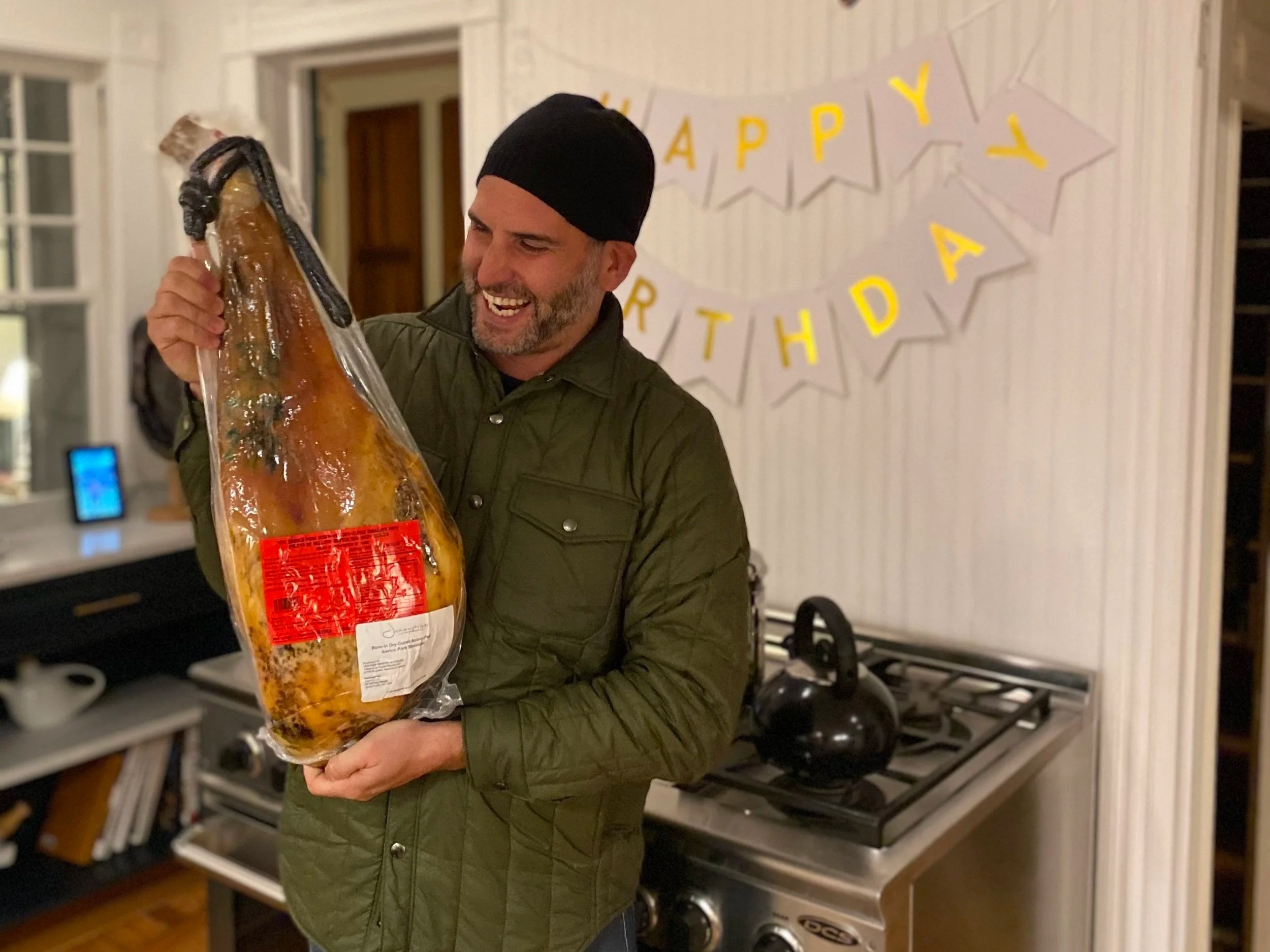
Every celebration deserves a little indulgence. For Sean, it was a long-awaited jamón leg — a gift from 2022 that still makes us smile.
The Celebration Season
The calendar between now and January is a parade of tradition — Halloween mischief, Sean’s birthday weekend, Thanksgiving feasts, our “House-iversary,” Christmas, and the festivities and reflection of the New Year. Each brings its own rhythm: moments of bustle followed by pause, of gratitude followed by gathering again.
Old houses feel these rhythms too. They’ve witnessed centuries of celebrations — each one layering warmth and memory into the walls. That’s part of why these rituals matter so much. Every birthday dinner, every polished window, every project finished before winter feels like we’re adding our verse to a much longer poem.
The season always begins with Sean’s birthday. We’ve hosted weekends that look more like reunions: friends staying overnight, slow breakfasts, hikes that end in shared meals and stories by the fire. Those days remind me that preparation and celebration are inseparable — one gives meaning to the other.
And like any enduring old-house project, a celebration worth remembering doesn’t just happen; it’s planned.
The Art of Planning — Lessons from the Workshop, the Office, and My Mom’s Kitchen Table
Long before Robins Hollow, I learned how to plan from the best teacher I know — my mom.
She had an uncanny ability to turn chaos into calm, whether it was school projects, family holidays, or life itself. She’d sit at the kitchen table with her notepad and pen, mapping the crazy of the weeks into order. Watching her, I learned that lists weren’t just about control; they were a way of caring for people.
Years later, in my corporate life, I perfected the art of the Gantt chart. I learned how to manage timelines, dependencies, budgets, and all the invisible work that turns vision into reality. It wasn’t glamorous, but it was foundational.
The lessons from those conference rooms and spreadsheets now echo through our workshop and kitchen — because whether you’re scaling a business or sanding a door, the principles are the same.
Someone once said — whether it was Benjamin Franklin, Winston Churchill, or another equally disciplined soul — “If you fail to plan, you are planning to fail.” And it’s true. I’ve seen it in every part of life.
The first time we hosted a big party at Robins Hollow, back in 2022, I forgot that truth for a moment.
It was Halloween, and we were still assembling the charcuterie board when guests in full costume began knocking at the door. They ended up helping — pouring wine, arranging crackers, laughing the whole time. It was imperfect and chaotic, but it worked.
Still, it wasn’t the kind of gracious hosting I aspire to (Ina Garten would’ve had her cocktail in hand at the door). That night taught me something: winging it can be fun, but it’s never peaceful.
Planning, like caretaking, doesn’t eliminate the surprises — it simply gives you the grace to enjoy them. Whether you’re preparing a dinner, a restoration project, or a life, good planning is the scaffolding that lets everything else take shape.
The Robins Hollow Planning Framework
A seven-step guide for planning anything — from building a cellar door to hosting a birthday dinner.
1. Define the goal. What are you really trying to build, host, or celebrate? A new skill? A shared memory? A warmer kitchen? Know the why before the how.
2. Identify who it’s for. Whether it’s Sean’s guests, next year’s garlic crop, or your future self — every plan has an audience. Clarity here makes every decision easier.
3. Break it into parts. Every project has its pieces — food, décor, lodging; or design, materials, finishing. Naming them early helps you see what’s possible (and what’s not).
4. Work backward from the finish line. Pick the event date or completion day, then map the steps in reverse. It’s easier to stay on pace when you know exactly how long the road is.
5. Assign roles (and keep each other updated). I handle logistics. Sean handles joinery — and playlists. Divide and conquer, but communicate. Good plans need connection as much as coordination.
6. Add buffer time. Something always takes longer. A good plan respects surprises and gives you room to breathe when life inevitably gets creative.
7. Anticipate the pivots.Weather, delays, forgotten RSVPs — think ahead so the joy doesn’t get lost in the scramble. Good planning isn’t rigid — it’s what gives you the freedom to enjoy the process.
The Joy in Preparation
The work before the celebration has its own kind of satisfaction — a rhythm that feels familiar to anyone who’s ever restored something old.
Every caretaker, host, or maker knows that planning isn’t about control; it’s about creating space for joy. The real purpose of preparation — whether you’re sanding a gate or setting a table — is to let you be present when the moment finally arrives.
Old houses, and relationships too, thrive on proactive care. They reward foresight and attention. A window sealed in autumn means a warmer room in winter. A birthday planned with intention means no one’s stuck in the kitchen when the laughter starts.
It’s the same principle: small acts of thoughtfulness multiplied over time become legacy.
When the last window is clean and the table is set, what’s left isn’t perfection — it’s presence. And that’s the real gift.
At the Heart of It All
By next weekend, the porch will be strung with lights, the kitchen full of good smells, and friends’ cars lined up along the drive. Sean will shake his head at the fuss, but I’ll see it for what it is — the first celebration in a long chain of many.
Planning is how we make room for gratitude. The more we prepare, the more we get to notice: the sound of laughter down the hall, the glow from the dining-room windows, the stillness that settles once everyone’s gone home.
As celebration season begins, I hope you’ll find your own reason to gather — and your own small project or ritual to plan. The best traditions, like the best houses, are built one thoughtful step at a time.
👉 Shop our favorite hosting and entertaining finds — from the tables we set to the tools we trust.
